Thursday, December 15, 2011
Final Chance To Make Back Points On The Mole Test
If you did not take advantage of the opportunity to make back points on the mole test from prior to Thanksgiving break, you have one more chance. After finals on Friday, December 16th, you can earn back 1/3rd of the points on the mole test. The activity will take 45 minutes to complete.

Tuesday, December 13, 2011
WHAT TO STUDY FOR THE FINAL TEST OF THE FIRST SEMESTER.
Below is a listing of concepts that you need to be familiar with for the final test. The test will consist of mostly multiple choice questions and some short answer questions. Though the book is not used much, this covers most of chapter 10(sections 10.5 through 10.11) and a lot of chapter 11 (sections 11.1, 11.2, 11.4 through11.7) in the book.
- Know the general concept of quantum mechanics. Orbitals are areas of highest probability (90%) of the location of an electron.
- Know that all matter moves in a wave pattern. This is especially true for electrons traveling in an orbital. The direction of the electron traveling is not known, but the path length is. The path length around the nucleus must be a multiple of an integer of the wavelength. An example of this is as follows: If an electron has a wavelength of 20 nanometers (nm), two possible path lengths could be 100 nanometers (nm) and 120 nm. Both path lengths are integers of the path length: (100 nm / 20 nm) = 5 (120 nm / 20 nm) = 6. Since the electron travels as a wave, the path lengths given would cause a crest to meet a crest and a trough to meet a trough. If the path length was 110 nm, the electron could not exist at this path length. The 110 nm path length in not an integer of wavelength ((110 nm / 20 nm) = 5.5). This would cause a crest to meet a trough and destructive interference would occur. The knowledge that the electrons travel as a wave gives credibility to the idea that electrons must exist in certain locations. This is supported by the emission spectrums of elements giving off very specific wavelengths of light when excited.
- Know the order of filling orbitals by using a periodic table. You will be supplied with a periodic table for the test.
- Be able to properly write electron configurations and/or orbital diagrams for elements in the ground (lowest energy) state. Also, be able to recognize if an electron is excited from an electron configuration or orbital diagram. This was covered in the electron configuration quiz given in class and can also be found in the notes package. An example of this: electron configuration of sodium (11 electrons) in the ground state is 1s^2 2s^2 2p^6 3s^1 - sodium in the excited state could be 1s^2 2s^2 2p^6 3s^0 4s^1
- Know the concept of penetration by an electron to lower principle energy levels and how this concept dictates the order on how the sub-levels and orbitals of different energy levels are filled. This concept is why the 4s sub-level is filled before the 3d sub-level and the 5s sub-level is filled before the 4d sub-level.
- Know the shape of an "s" orbital (sphere) and a "p" orbital (dumb bell)
- Know the sub-levels that are in each principle energy level. 1st - s only; 2nd - s and p; 3rd - s, p, and d; 4th (and on) s, p, d, and f.
- Know how many orbitals are in each sub-level. You should be able to calculate how many electrons could be held in a particular principle energy. For example: How many electrons could be in the 4th principle energy level? The 4th principle energy level is the first time all of the sub-levels are present. Therefore; 1 orbital for the s, 3 orbitals for the p, 5 orbitals for the d, and 7 orbitals for the f will be a total of 16 orbitals. Each orbital can hold 2 electrons for a total of 32 electrons in the 4th principle energy level.
- Know how to write orbital diagrams (show orbitals with arrows representing the electrons), complete electron configurations, and noble gas electron configurations.
- Know the abnormalities for the electron configurations of chromium and copper.
- Know para-magnetism and di-magnetism based upon unpaired and paired electrons in an orbital. An orbital diagram with many unpaired electrons in orbitals would exhibit magnetic character while an orbital diagram with all paired electrons in orbitals would show little to no magnetic character.
- Know that valence electrons are the electrons in the outer-most s and p sub-levels. Any electron that is not a valence electron in an atom is known as a core electron.
- Know the concept of shielding by the core electrons to minimize the effect of the protons in the nucleus on the valence electrons.
- Know all of the general periodic trends of atomic radius (size), 1st ionization energy, electron affinity, and electronegativity. Be able to define what all periodic trends are. Be able to explain in detail the factors that attribute to a periodic trend. Example #1 - Size of atoms across a period (horizontal row on the periodic table) decrease from left to right. The reason is the number of protons in the nucleus increase as you move to the right across the periodic table, but the number of core electrons remains the same. The increased positive charge of the protons and the shielding staying the same allows the protons to attract the valence electrons in closer to the nucleus. Example #2 - 1st ionization energy of atoms decreases going down a group (vertical columns on the periodic table). The reason is the atoms get larger as successive energy levels are added. The greater distance between the nucleus and valence electrons and increase in the amount of shielding due to more core electrons causes the protons in the nucleus to have less effect on the valence electrons. Because of the diminished effect, less energy is needed to remove an electron from the atom.
- Know why successive ionization energies get larger and larger. Know that a substantial increase in an ionization energy value from one electron to the next would be an indication of the removal of a core electron.
- Know that chemical bonds are made to lower the potential energy of the atoms involved in the bond. The lowering of the potential energy of the system makes the atoms in the molecule more stable. An example of this was done numerous times in class looking at the system of the energy input (ionization energy) to take the one valence electron away from a sodium atom compared to the energy release (electron affinity) of a fluorine atom gaining an electron to complete its outer valence level. The total process would be exothermic because the energy release from fluorine would be greater in magnitude than the energy consumption of sodium. Be able to apply this concept to other scenario in which the relative values of ionization energy and electron affinity are known.
- Know why the mole concept is important for comparison of ionization energy values and electron affinity values. Both values are reported in kilojoules per mole. The mole concept allows for equal comparisons because the number of atoms and electrons involved with the either process have been counted using the mole concept.
- Know that valence electrons are the electrons involved in bonding.
- Know how to define the two types of chemical bonds: Covalent bonds - sharing of electrons between atoms to achieve (in most cases) an octet (8 valence electrons) or a duet (2 valence electrons - hydrogen most of the time). Occurs between non-metal and non-metal elements (most of the time). A covalent bond is technically defined as an electronegativity difference between the two elements in the bond of less than or equal to 1.7. Ionic bonds - transfer of electrons between atoms to achieve an octet (or duet) for both atoms. Occurs between metal and non-metal elements (in most cases). An ionic bond is technically defined as an electronegativity difference between the two elements in the bond of greater than 1.7.
- An electronegativity table will be supplied to you for bond type determination.
- An electronegativity difference of less-than or equal to 1.7 does not mean electrons are always shared between the elements. It means the electrons are shared a majority of the time and some transferring of electrons does occur. An electronegativity difference of greater than 1.7 does not mean a complete transfer of electrons from one atom to another. It means electrons are transferred from the less electronegative atom to the more electronegative atom a majority of the time and some sharing of the valence electron(s) does occur.
- Know the term / concept of isoelectronic. This is covered in the second VODCast for the Chemical Bonding / Lewis Dot Diagram worksheet.
- Know how the relative sizes of ions compared to their original atom sizes. Cations (positive ions) will always be smaller than their original atoms and anions (negative ions) will always be larger than their original atoms. The reasoning for the trends is givenin the second VODCast for the Chemical Bonding / Lewis Dot Diagram worksheet.
- Know how to show in a Lewis dot diagram and define: a single covalent bond, a double covalent bond, and a triple covalent bond.
- Know how to draw a Lewis dot diagram and structural diagram of a chemical compound. This is covered in the first and second VODCasts for the Chemical Bonding / Lewis Dot Diagram worksheet.
The test will take roughly 50 minutes of the 90 minute testing period. The point value of the test will be that of some of our larger tests this semester - 50 to 60 points. With the remaining time in the testing period, we will do a lab. Please bring pennies for the lab. You will be converting the copper of the pennies to "gold". (Actually, you will be making brass that looks like gold.)
Tuesday, November 15, 2011
Electromagnetic Spectrum
Below is an image for the electromagnetic spectrum. You may need to use it to complete your the EM / Bohr model work packet.

Tuesday, November 8, 2011
Test and Quiz Reminder
Tomorrow, Wednesday, November 9th, 2011, you will have a quiz covering the hydrate lab that was completed today in class. The calculations for the quiz will mimick the calculations done for the lab and pre-lab. Also, start preparing for the mole test which will be given on Thursday, October 10th, 2011. There is a review packet and key posted a a pdf. on today's date on the class events calendar.
Friday, November 4, 2011
MOLE DOLL
Below is the cut-out image to be used to make your mole doll, if you choose. You will get 10 points extra credit for making just the regular sized doll with no extras. You can get 20 points extra credit if you give your doll a theme. Examples are "Holy Moley" and have your mole dressed as an angel, priest, nun,..... You get the idea. Have your theme deal with the word "mole", or just dress it up in some neat, but tasteful way. You can also get 20 points extra credit by taking the image below and enlarging it and make a super-sized mole. Super-sized is anything over 1 and a half feet in length. I would be totally impressed if a couple of people got together and made a life sized mole. You can save the image of the cut-out below and then print it. You will have to show some sewing skills (or you parents sewing skills) to make this. Involve your mom. Mom's love this stuff. The mole will be due next Friday, the 11th of November, 2011.


Tuesday, November 1, 2011
Empirical and Molecular Formulas / Flipped Classroom
You are going to be taking part in a teaching experiment. The experiment is known as the "Flipped Classroom". The idea of the flip will be that you will learn about the concepts outside of class and then do your "homework" in class. You will be "lectured" on the new concepts via a series of three VODCasts (Video On Demand) from the comfort of your own home or the computer lab in the HHS library. I have made minnie movies to introduce the new concepts and to guide you through the first seven problems of the packet that you were given in class on Percent Composition, Empirical and Molecular Formulas. The VODCast files can be found on the Events Calendar of the class website under the date, Wednesday, November 2nd, 2011. It is your responsibility to view the videos, write notes on the material, and complete the example problems prior to class on Thursday, November 3rd, 2011. On that Thursday, you will come to class and work on the remaining problems of the packet in small groups. Below is a list of concepts that you need to be familiar with after viewing the VODCasts and doing the example problems in the work packet that was given to you.
- Be able to define percent composition, empirical formula, and molecular formula.
- Know the process of how to find the percent composition of individual elements in a compound.
- Know that empirical formulas are the ratios of elements in a compound based upon the counted unit of the mole.
- Know how to treat the amounts of elements in a compound when percentages are given.
- Know how to deal with a situation where the ratio of an empirical formula does not work out to be whole numbers, but rather one or more of the elements in the compound has a subscript that is a decimal / fraction number.
- Know how to determine a molecular formula by comparing the molar mass of a molecular formula to the molar mass of an empirical formula.
- Know how experimentation is needed to determine the "real" molar mass of a molecular formula. Know how relative molar masses are determined using a mass spectrometer.
Before you come to class on Thursday, November 3rd, 2011, you must have all seven example problems completed in the work packet and notes taken from the VODCasts. You will be graded on this preparation work.
Mole Worksheet
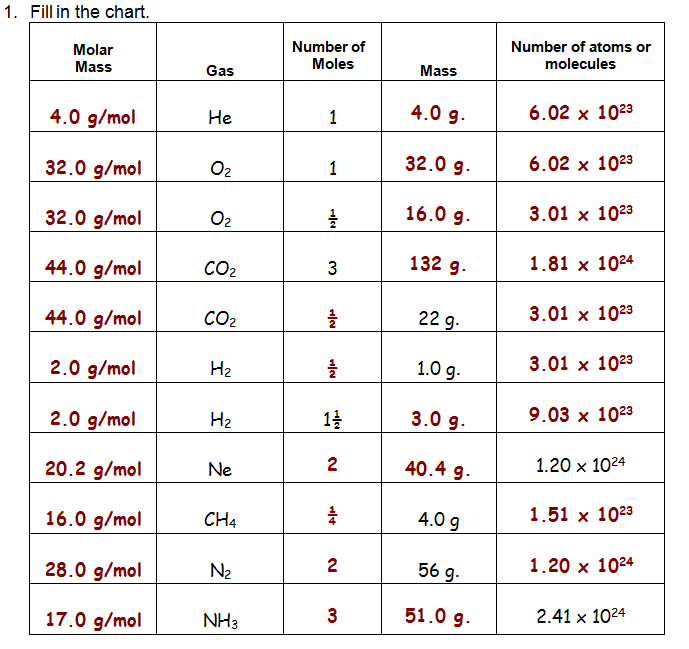
Below is a solutions guide to the Mole Worksheet table that was given out in class today. I realized during 6th hour today that there was not information to work with for CH4 and NH3. Do not worry about finishing the chart for those two substances. The answers for the worksheet are given on the back of the worksheet at the bottom of the page. You may also want to view the VODCast that is posted on today's date, Tuesday, November 1st, 2011 on the class calendar. Remember, you need Quicktime on your computer to view the movie file. You will have a quiz over the material covered on the mole worksheet, so make sure that you try and master the material. The quiz will be going into the homework category of your grade. Also, all questions on the Bean Lab must be completed for tomorrow. The lab will be collected at the beginning of class.

Subscribe to:
Posts (Atom)