Tuesday, April 10, 2012

Gas Laws Test

Tomorrow (Wednesday, April 11th, 2012) is the test covering gas laws. Below are four short review problems and the solutions to the problems. The review problems are optional. All material on all worksheets is fair game for the exam. The complete keys for the Combined Gas Law Worksheet and Ideal Gas Law Worksheet can be found the Events Calendar of the class web-site. Please look over the Manometer Worksheet that was done early in the chapter. All calculator skills are fair game for the exam. The exam will consist of 22 multiple choice questions. You will be given all equations, constants and conversions factors for the exam. Come and see me before the exam is you have any questions.


Wednesday, March 14, 2012

More Electro Chemistry Review Material

Below are images of the review sheet given in class. The two answers for questions #13 and #14 are #13 lead and #14 aluminum. I have also included the key to the group quiz given yesterday in class. The test tomorrow consists of 22 questions. The questions are a combination of multiple choice and written responses. On the class Events Calendar under today's date, I have posted a pdf file of the key to the half reactions worksheet if you would like to review that material. I will be at school by 6:50 tomorrow if you need to ask me any questions.


Tuesday, March 13, 2012

Review for Electrochemistry Test

Below are keys to materials that are useful for you to review for the test on Electrochemistry that will be given on Thursday, March 15th, 2012. On the Events Calendar date of Tuesday, March 13th, 2012, two files can be found for reviewing for the test. Tomorrow, Wednesday, March 14th, most of the class period will be spent reviewing for the exam.


Tuesday, February 21, 2012

Chemical Reactions Review

Below is a solutions guide to the optional review for tomorrow's test on chemical reactions. The test will consist of 28 multiple choice questions and seven short answer problems. The multiple choice part of the test will cover balancing reactions, classifying types of reactions, use of an activity series for predicting if reactions will occur, and use of a solubility table. The short answer problems will be like those on the Chemical Reactions Review that you worked on in class today. A complete VODCast key for the Chemical Reactions Review is available on the class Events Calendar on the date Tuesday, February 21st, 2012. The only type of reaction that you will be held accountable on to know the state of matter will be double replacement reactions. Below the key for the optional review is a brief tutorial on how to balance equations. Come and see me tomorrow morning if you have any questions.


For those of you experiencing a little difficulty on the balancing chemical reactions worksheet, I have some advice for a possible sticking point.


Elements combine in whole number, that we know to be true. Thus, we need to have the smallest whole number ratio of the coefficients used to balance the equation. To balance an equation initially, you may use a fraction, but then you must modify the coefficients to make them whole numbers. Below is an example.


Reaction: C3H6O2 + O2 --> CO2 + H2O


Hint: Wait to balance oxygen last since placing a coefficient in front of elemental oxygen (O2) will not change any other elements.


Initial balancing: C3H6O2 + ?O2 --> 3CO2 + 3H2O


The carbons and hydrogens have been balanced. All that is left are the oxygens. There are a total of 9 oxygens of the product side (right of the arrow). Notice that 2 oxygens exist in the compound on the reactant side. Thus, to balance out the oxygens, an equation can be set up.


2 + x = 9 --> x = 7 --> Seven oxygens are required to balance the reaction, so this dictates that we use a coefficient in front of oxygen (O2) that will produce 7 oxygens. This will cause a coefficient of 3.5 to be used. This is not a whole number, but we can deal with that later.


Almost balanced: C3H6O2 + 3.5O2 --> 3CO2 + 3H2O


Having a fraction as a coefficient is not allowed, thus we must convert 3.5 to a whole number. To accomplish this, we will multiply 3.5 by 2. Just like in algebra, if something is done to one number, we must do the same thing to all of the numbers. Thus, all coefficients will be multiplied by 2. Doing this keeps the equation balanced.


Almost, nearly balanced: 2(C3H6O2 + 3.5O2 --> 3CO2 + 3H2O)


BALANCED!! 2C3H6O2 + 7O2 --> 6CO2 + 6H2O


Make sure that you check all of the elements on each side of the reaction to ensure that is has been balanced correctly.

Thursday, February 16, 2012

Key for Word Equations Worksheet

Below is the key for the "Word Equations" worksheet. A common mistake made is forgetting which elements are diatomic elements. The elements hydrogen, nitrogen, oxygen, fluorine, chlorine, bromine, and iodine all are two atom molecules when isolated alone in nature. The VODCast for the "Chemical Reactions Review" has been posted under the date Friday, February 17th, 2012. The "Chemical Reactions Review" problems are on the back of the Word Equations worksheet. Please do the example problems before class on Tuesday, February 21st, 2012. The problems that are not shown as examples will be completed by you with your work groups in class on Tuesday. After classes are complete on Tuesday, another VODCast with all of the solutions to the review will be posted. The test for the chemical reactions unit will be given on Wednesday, February 22nd, 2012.

The chapters in the book that cover this material are Chapter 6 and Chapter 7. Sections 7.4 and 7.5 will not be covered by Wednesday's test. They will be covered later in the semester.


Tuesday, February 14, 2012

Quiz Review for Wednesday, February 15th, 2012

Tomorrow (Wednesday, February 15th, 2012) will be a quiz over balancing equations, classifying types of reactions, the use of the activity series chart, and the use of the solubility table. The types of reactions were given in your notes, but I will summarize them again in this blog post. The types of reactions and how they are abreviated are shown below. The key to the types of reactions on the balancing reactions worksheet are given below.


  • synthesis reactions (shown as "syn" below) - less complex atoms or molecules become more complex molecules. Remember, a three element compound is more complex than a two element compound.

  • decomposition reactions (shown as "decomp" below) - more complex molecules become less complex molecules or atoms. A two element compound is less complex than a three element compound.

  • dissociation reactions (shown as "diss" below) - ionic compounds, when placed in water, dissolve in water to go from solid to aqueous. The aqueous products will always be shown as ions with charges.

  • combustion reactions (shown as "comb" below) - elements oxygen (O2) must always be a reactant. Each product must contain the element oxygen. **All hydrocarbons (compounds that contain the elements carbon, hydrogen, and sometimes oxygen), when combusted, produce the products carbon dioxide and water. Both CO2 and H2O have oxygen in them.

  • double replacement reactions (shown as "D.R." below) - two aqueous ionic compounds switch ions. The metal (positive ion) of one compound possibly combines with the non-metal (negative ion) of another and vice-versa. A new state of matter matter must be produced. This is usually a precipitate (solid), but not always.

  • single replacement reactions (shown as "S.R." below) - a single element and an ionic compound are reactants. A general rule is "a metal replaces a metal and a non-metal replaces a non-metal" for single replacement reactions. If the single element is a metal and is more active than the metal in the ionic compound, the more active metal will replace the less active metal in the compound. Example #1: Cu +2AgNO3 --> Cu(NO3)2 + 2Ag OR a more active non-metal will replace a less active non-metal in the ionic compound. Example #2: Cl2 + CaBr2 --> CaCl2 +Br2. A metal or non-metal's reactivity can be determined by where it is on the activity series chart given in class. If a less active element is the element by itself, it will not replace the more active element. This will be classified as a NO REACTION (N.R.)

**Some reactions can have more than one type of classification. This often occurs with synthesis reactions that involve elemental oxygen as a reactant. They can be often be classified as combustion reactions also. Also, some of the reactions in the worksheet do not always fit nicely into a category, so that is indicated by a question mark. You will not be given any questionable reactions on the quiz.


The quiz will require you to do the following:


  • Balance equations and classify them just like the work sheet given in class.

  • You will also be shown single replacement reactions and asked to predict if a reaction will occur because the single element reactant is more active than its like element in the compound or the reaction will not occur because the single element reactant is less active than its like element in the compound.

  • You will be given ionic compounds, and using a solubility table, determine if the compound is soluble in water (aqueous) or not soluble in water (solid).

**You will be able to use your own periodic table and solubility / activity series table on the quiz. The quiz will be going into the "Assessment Category" of your grade.


Saturday, February 11, 2012

New VodCast - Writing Double Replacement Rxns

The new VODCast showing how to write double replacement reactions for the Observing Chemical Reactions in Solution Lab is available on the Events Calendar under the date Saturday, February 11th, 2012. Please view it prior to class on Monday to prepare for the lab. Have a good weekend.

Tuesday, January 31, 2012

Keys for Naming and Writing Chemical Compound Formulas

Below are the answer keys to all of the worksheet given in class on naming and writing compound formulas. There will be a diagnostic quiz given on Wednesday, February 1st, 2012 to assess your mastery of the material. If you do not feel comfortable with the material after Wednesday's quiz, on the Events Calendar under the date Wednesday, February 1st, 2012 is a VODCast that you can watch for remedial help. A worksheet is available for more practice. The VODCast covers all of the material presented on the worksheet. There will be a quiz that will go in the Assessment Category of your grade on Friday, 2/3/2012. Also on that Friday, a quiz will be given over your general science knowledge. Any points earned on that exam will be given to you as extra credit towards your Assessment Category. The points will be pro-rated.


Monday, January 23, 2012

Major Exam, Wednesday, 1/25/2012

Your first major exam of the semester will be on Wednesday, January 25th, 2012. I have not finished writing the exam yet, but I can tell you that the test will be between 30 and 40 questions. It will be mostly multiple choice with a few free response questions. Below I have written out the key concepts that you need to be aware of to do well on the exam.


  • Be able to complete a Lewis dot structure for a compound given.


  • Based upon a Lewis dot structure, you must be able to determine the parent geometry, number of ligands around the central atom, number of bonding and non-bonding ligands around the central atom, and the molecular geometry.


  • Know that non-bonding ligands on the central atom repel more than bonding ligands. This has an influence on the bond angles. Example: tetrahedral molecular geometry (4 bonding ligands) has a bond angle of 109.5^o; trigonal pyramidal molecular geometry (3 bonding ligands and one non-bonding ligand) has a bond angle of 107^o; and bent molecular geometry (2 bonding ligands and 2 non-bonding ligands) has a bond angle of 104.5^o. You will be supplied a table of parent and molecular geometry names and the angles associated with each molecular geometry. An image of the table is at the bottom of this post.


  • Based upon molecular geometry and the ability to visualize a 3-D model of the molecule with dipoles (based on electronegativities), determine if the molecule is polar or non-polar. This is based upon the symmetrical or asymmetrical distribution of charge around the outside of the molecule.


  • Based upon the polarity of the molecule, determine the type of intermolecular bonds that would occur between molecules of the same type.


  • Non-polar molecules will experience only London dispersion forces.


  • London dispersion forces are the weakest of the types of intermolecular bonds. They are created by a temporary dipole randomly occurring across a molecule do to movement of electrons within the molecule. London dispersion forces strength difference comes from the different sizes of molecules. Larger molecules have more surface area for bonding and more electrons to create a greater temporary dipole.


  • Polar molecules can experience dipole-dipole forces or hydrogen bonding intermolecular forces. Dipole-dipole forces are stronger than London dispersion forces. Hydrogen bonding is a special type of dipole-dipole force because it occurs between polar molecules that contain hydrogen covalently bonded to fluorine, oxygen, or nitrogen. Hydrogen bonding is the strongest of the intermolecular bond types.


  • Know the reasons why hydrogen bonding is the strongest type of intermolecular bond. (1) The atoms (H, F, O, and N) are all small atoms which allows for the molecules to fit in close together for stronger bonding. (2) The large electronegativities of fluorine, oxygen, and nitrogen create a large charge separation when covalently bonded to hydrogen. (3) Hydrogen has no core electrons. When hydrogen's one electron is closer to the other atom in a covalent bond due to the other element being more electronegative, the proton of hydrogen is completely exposed. (A.k.a. - hydrogen is a mooner)


  • **Please note: The strength of the intermolecular (between molecules) bonds are only to be compared to one another. Both ionic bonds and covalent bonds between atoms (intramolecular) are much stronger than any of the intermolecular bond types (London dispersion, dipole-dipole, hydrogen bonding).


  • **Please note: All molecules experience London dispersion forces. This is why the size of the molecule (more surface area / more electrons for temporary dipole formation) is the indicator of intermolecular bond strength when the type of intermolecular bonds are the same when comparing more than one molecule.


  • Know how the concepts of melting/freezing point, boiling/condensation point, heat of fusion, and heat of vaporization are based upon intermolecular bond strength. (1) low values of all of the concepts listed will have weaker intermolecular bonds. (2) high values of all of the concepts listed will have stronger intermolecular bonds.


  • Know how to compare intermolecular bond strengths on the values of joules or kilojoules per mole. Know that the mole concept is needed to accurately assess bond strength do to the amount of energy used in comparison with the number of bonds broken. This comparison cannot be made with energy value per gram of substance.


  • Know the graphical concepts of the Intermolecular Bond Strength / Vaporization lab. Know how the graphs of the lab were interpreted. The weakest intermolecular bonding type belonged to acetone, so it finished evaporating first. This was indicated by the temperature on the graph for acetone beginning to rise first. Once all the acetone had evaporated, energy was no longer being taken from the temperature probe to evaporate the liquid acetone (break bonds between the molecules). Energy from the room then went back into the temperature probe to raise the temperature of the probe. Intermolecular bond strength was determined by when the temperature increase occurred. The longer it took for the temperature to rise again, the stronger the intermolecular bonds.


  • Be able to look at a phase change (Temperature vs Time) graph and determine the state of matter and (melting/freezing) / (boiling/condensation) points of a substance.


  • Know that heat of fusion and heat of vaporization calculations would take place at the plateau's of the graphs.


  • Know that any sloped part on a phase change graph would require (q=s x m x delta T) to determine the amount of energy associated with the change in molecular motion of the substance.


  • Know how to solve for any variable associated with the heat of fusion or heat of vaporization equations.


  • Be able to calculate the total amount of energy associated with the heating or cooling of a substance. This would involve multiple calculations using the heat of fusion and/or heat of vaporization with (q=s x m x delta T).


  • THERE WILL BE NO QUESTIONS ABOUT THE ENERGY NEEDED TO MELT ICE LAB.


  • Look at all material used for the unit of study. Watch the VODCast of the first work packet done in class. A key (pdf file) for the second work packet is posted on the Events Calendar under the date, Monday, January 23rd, 2012.


  • You will get to use your periodic table. I will supply you with an electronegativity table and a copy of the diagram below. You will also be supplied with all equation for the exam.

Sunday, January 22, 2012

Practice For Your Quiz Tomorrow!

On Monday, January 23rd, 2012, you will be taking a quiz covering the material presented in the"Energy Needed to Melt Ice Lab". I have made a VODCast showing a summary of the lab procedure, concepts associated with the lab, and how to perform the calculations associated with the lab. The VODCast is posted on the Events Calendar of the class website under the date Sunday, January 22nd, 2012. You will be given all of the equation needed to complete the exam.

After you complete the quiz, we will be using the remainder of the time in class to review for the major exam that will be given on Tuesday, January 24th, 2012. You need to have the 2nd work packet for Heat of Fusion / Vaporization completed tomorrow before class to receive credit for the work done on the packet.

Tuesday, January 17, 2012

VODCast for Heat of Fusion / Vaporization Packet

The VODCast for parts (A) through (G) of the Heat of Fusion / Vaporization Work Packet has been posted under the date Tuesday, January 17th, 2012 on the class Events Calendar. The remaining problems (H through M) will be completed in another VODCast by tomorrow. Remember, all parts of the work packet must be completed prior to class on Thursday, January 19th, 2012. On that day, you will get another packet of questions and problems that you will complete with your work groups using the "flipped" classroom model.

Thursday, December 15, 2011

Final Chance To Make Back Points On The Mole Test

If you did not take advantage of the opportunity to make back points on the mole test from prior to Thanksgiving break, you have one more chance. After finals on Friday, December 16th, you can earn back 1/3rd of the points on the mole test. The activity will take 45 minutes to complete.

Tuesday, December 13, 2011

WHAT TO STUDY FOR THE FINAL TEST OF THE FIRST SEMESTER.

Below is a listing of concepts that you need to be familiar with for the final test. The test will consist of mostly multiple choice questions and some short answer questions. Though the book is not used much, this covers most of chapter 10(sections 10.5 through 10.11) and a lot of chapter 11 (sections 11.1, 11.2, 11.4 through11.7) in the book.


  • Know the general concept of quantum mechanics. Orbitals are areas of highest probability (90%) of the location of an electron.


  • Know that all matter moves in a wave pattern. This is especially true for electrons traveling in an orbital. The direction of the electron traveling is not known, but the path length is. The path length around the nucleus must be a multiple of an integer of the wavelength. An example of this is as follows: If an electron has a wavelength of 20 nanometers (nm), two possible path lengths could be 100 nanometers (nm) and 120 nm. Both path lengths are integers of the path length: (100 nm / 20 nm) = 5 (120 nm / 20 nm) = 6. Since the electron travels as a wave, the path lengths given would cause a crest to meet a crest and a trough to meet a trough. If the path length was 110 nm, the electron could not exist at this path length. The 110 nm path length in not an integer of wavelength ((110 nm / 20 nm) = 5.5). This would cause a crest to meet a trough and destructive interference would occur. The knowledge that the electrons travel as a wave gives credibility to the idea that electrons must exist in certain locations. This is supported by the emission spectrums of elements giving off very specific wavelengths of light when excited.

  • Know the order of filling orbitals by using a periodic table. You will be supplied with a periodic table for the test.


  • Be able to properly write electron configurations and/or orbital diagrams for elements in the ground (lowest energy) state. Also, be able to recognize if an electron is excited from an electron configuration or orbital diagram. This was covered in the electron configuration quiz given in class and can also be found in the notes package. An example of this: electron configuration of sodium (11 electrons) in the ground state is 1s^2 2s^2 2p^6 3s^1 - sodium in the excited state could be 1s^2 2s^2 2p^6 3s^0 4s^1


  • Know the concept of penetration by an electron to lower principle energy levels and how this concept dictates the order on how the sub-levels and orbitals of different energy levels are filled. This concept is why the 4s sub-level is filled before the 3d sub-level and the 5s sub-level is filled before the 4d sub-level.


  • Know the shape of an "s" orbital (sphere) and a "p" orbital (dumb bell)


  • Know the sub-levels that are in each principle energy level. 1st - s only; 2nd - s and p; 3rd - s, p, and d; 4th (and on) s, p, d, and f.


  • Know how many orbitals are in each sub-level. You should be able to calculate how many electrons could be held in a particular principle energy. For example: How many electrons could be in the 4th principle energy level? The 4th principle energy level is the first time all of the sub-levels are present. Therefore; 1 orbital for the s, 3 orbitals for the p, 5 orbitals for the d, and 7 orbitals for the f will be a total of 16 orbitals. Each orbital can hold 2 electrons for a total of 32 electrons in the 4th principle energy level.


  • Know how to write orbital diagrams (show orbitals with arrows representing the electrons), complete electron configurations, and noble gas electron configurations.


  • Know the abnormalities for the electron configurations of chromium and copper.


  • Know para-magnetism and di-magnetism based upon unpaired and paired electrons in an orbital. An orbital diagram with many unpaired electrons in orbitals would exhibit magnetic character while an orbital diagram with all paired electrons in orbitals would show little to no magnetic character.


  • Know that valence electrons are the electrons in the outer-most s and p sub-levels. Any electron that is not a valence electron in an atom is known as a core electron.


  • Know the concept of shielding by the core electrons to minimize the effect of the protons in the nucleus on the valence electrons.


  • Know all of the general periodic trends of atomic radius (size), 1st ionization energy, electron affinity, and electronegativity. Be able to define what all periodic trends are. Be able to explain in detail the factors that attribute to a periodic trend. Example #1 - Size of atoms across a period (horizontal row on the periodic table) decrease from left to right. The reason is the number of protons in the nucleus increase as you move to the right across the periodic table, but the number of core electrons remains the same. The increased positive charge of the protons and the shielding staying the same allows the protons to attract the valence electrons in closer to the nucleus. Example #2 - 1st ionization energy of atoms decreases going down a group (vertical columns on the periodic table). The reason is the atoms get larger as successive energy levels are added. The greater distance between the nucleus and valence electrons and increase in the amount of shielding due to more core electrons causes the protons in the nucleus to have less effect on the valence electrons. Because of the diminished effect, less energy is needed to remove an electron from the atom.

  • Know why successive ionization energies get larger and larger. Know that a substantial increase in an ionization energy value from one electron to the next would be an indication of the removal of a core electron.


  • Know that chemical bonds are made to lower the potential energy of the atoms involved in the bond. The lowering of the potential energy of the system makes the atoms in the molecule more stable. An example of this was done numerous times in class looking at the system of the energy input (ionization energy) to take the one valence electron away from a sodium atom compared to the energy release (electron affinity) of a fluorine atom gaining an electron to complete its outer valence level. The total process would be exothermic because the energy release from fluorine would be greater in magnitude than the energy consumption of sodium. Be able to apply this concept to other scenario in which the relative values of ionization energy and electron affinity are known.


  • Know why the mole concept is important for comparison of ionization energy values and electron affinity values. Both values are reported in kilojoules per mole. The mole concept allows for equal comparisons because the number of atoms and electrons involved with the either process have been counted using the mole concept.


  • Know that valence electrons are the electrons involved in bonding.


  • Know how to define the two types of chemical bonds: Covalent bonds - sharing of electrons between atoms to achieve (in most cases) an octet (8 valence electrons) or a duet (2 valence electrons - hydrogen most of the time). Occurs between non-metal and non-metal elements (most of the time). A covalent bond is technically defined as an electronegativity difference between the two elements in the bond of less than or equal to 1.7. Ionic bonds - transfer of electrons between atoms to achieve an octet (or duet) for both atoms. Occurs between metal and non-metal elements (in most cases). An ionic bond is technically defined as an electronegativity difference between the two elements in the bond of greater than 1.7.


  • An electronegativity table will be supplied to you for bond type determination.


  • An electronegativity difference of less-than or equal to 1.7 does not mean electrons are always shared between the elements. It means the electrons are shared a majority of the time and some transferring of electrons does occur. An electronegativity difference of greater than 1.7 does not mean a complete transfer of electrons from one atom to another. It means electrons are transferred from the less electronegative atom to the more electronegative atom a majority of the time and some sharing of the valence electron(s) does occur.


  • Know the term / concept of isoelectronic. This is covered in the second VODCast for the Chemical Bonding / Lewis Dot Diagram worksheet.


  • Know how the relative sizes of ions compared to their original atom sizes. Cations (positive ions) will always be smaller than their original atoms and anions (negative ions) will always be larger than their original atoms. The reasoning for the trends is givenin the second VODCast for the Chemical Bonding / Lewis Dot Diagram worksheet.


  • Know how to show in a Lewis dot diagram and define: a single covalent bond, a double covalent bond, and a triple covalent bond.


  • Know how to draw a Lewis dot diagram and structural diagram of a chemical compound. This is covered in the first and second VODCasts for the Chemical Bonding / Lewis Dot Diagram worksheet.


The test will take roughly 50 minutes of the 90 minute testing period. The point value of the test will be that of some of our larger tests this semester - 50 to 60 points. With the remaining time in the testing period, we will do a lab. Please bring pennies for the lab. You will be converting the copper of the pennies to "gold". (Actually, you will be making brass that looks like gold.)

Tuesday, November 15, 2011

Electromagnetic Spectrum

Below is an image for the electromagnetic spectrum. You may need to use it to complete your the EM / Bohr model work packet.

Tuesday, November 8, 2011

Test and Quiz Reminder

Tomorrow, Wednesday, November 9th, 2011, you will have a quiz covering the hydrate lab that was completed today in class. The calculations for the quiz will mimick the calculations done for the lab and pre-lab. Also, start preparing for the mole test which will be given on Thursday, October 10th, 2011. There is a review packet and key posted a a pdf. on today's date on the class events calendar.

Friday, November 4, 2011

MOLE DOLL

Below is the cut-out image to be used to make your mole doll, if you choose. You will get 10 points extra credit for making just the regular sized doll with no extras. You can get 20 points extra credit if you give your doll a theme. Examples are "Holy Moley" and have your mole dressed as an angel, priest, nun,..... You get the idea. Have your theme deal with the word "mole", or just dress it up in some neat, but tasteful way. You can also get 20 points extra credit by taking the image below and enlarging it and make a super-sized mole. Super-sized is anything over 1 and a half feet in length. I would be totally impressed if a couple of people got together and made a life sized mole. You can save the image of the cut-out below and then print it. You will have to show some sewing skills (or you parents sewing skills) to make this. Involve your mom. Mom's love this stuff. The mole will be due next Friday, the 11th of November, 2011.


Tuesday, November 1, 2011

Empirical and Molecular Formulas / Flipped Classroom

You are going to be taking part in a teaching experiment. The experiment is known as the "Flipped Classroom". The idea of the flip will be that you will learn about the concepts outside of class and then do your "homework" in class. You will be "lectured" on the new concepts via a series of three VODCasts (Video On Demand) from the comfort of your own home or the computer lab in the HHS library. I have made minnie movies to introduce the new concepts and to guide you through the first seven problems of the packet that you were given in class on Percent Composition, Empirical and Molecular Formulas. The VODCast files can be found on the Events Calendar of the class website under the date, Wednesday, November 2nd, 2011. It is your responsibility to view the videos, write notes on the material, and complete the example problems prior to class on Thursday, November 3rd, 2011. On that Thursday, you will come to class and work on the remaining problems of the packet in small groups. Below is a list of concepts that you need to be familiar with after viewing the VODCasts and doing the example problems in the work packet that was given to you.

  • Be able to define percent composition, empirical formula, and molecular formula.
  • Know the process of how to find the percent composition of individual elements in a compound.
  • Know that empirical formulas are the ratios of elements in a compound based upon the counted unit of the mole.
  • Know how to treat the amounts of elements in a compound when percentages are given.
  • Know how to deal with a situation where the ratio of an empirical formula does not work out to be whole numbers, but rather one or more of the elements in the compound has a subscript that is a decimal / fraction number.
  • Know how to determine a molecular formula by comparing the molar mass of a molecular formula to the molar mass of an empirical formula.
  • Know how experimentation is needed to determine the "real" molar mass of a molecular formula. Know how relative molar masses are determined using a mass spectrometer.
Before you come to class on Thursday, November 3rd, 2011, you must have all seven example problems completed in the work packet and notes taken from the VODCasts. You will be graded on this preparation work.

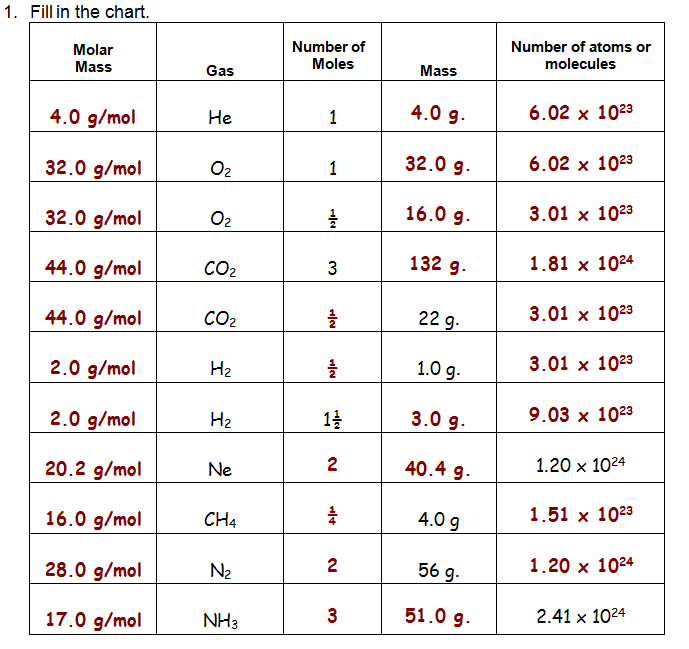
Mole Worksheet

Below is a solutions guide to the Mole Worksheet table that was given out in class today. I realized during 6th hour today that there was not information to work with for CH4 and NH3. Do not worry about finishing the chart for those two substances. The answers for the worksheet are given on the back of the worksheet at the bottom of the page. You may also want to view the VODCast that is posted on today's date, Tuesday, November 1st, 2011 on the class calendar. Remember, you need Quicktime on your computer to view the movie file. You will have a quiz over the material covered on the mole worksheet, so make sure that you try and master the material. The quiz will be going into the homework category of your grade. Also, all questions on the Bean Lab must be completed for tomorrow. The lab will be collected at the beginning of class.


Monday, October 24, 2011

Chapters 4 and 18 Test - Wednesday, October 26th, 2011

On Wednesday, October 26th, 2011, you will be taking a test covering the material covered in Chapters 4 and 18 of the chemistry textbook for the class. The sections of one through seven will be tested in Chapter 4 and sections one through four will be tested in Chapter 18. You may want to read those sections specified, but know that all material that is covered by the exam is presented in the handouts and worksheets of the unit. The test will consist of both multiple choice questions and short answer / written questions. On the short answer portion, you may be asked to draw on diagrams to illustrate concepts within the unit of study. A practice test is available on the class calendar on the date Monday, October 24th, 2011. Realize the practice test only covers some of the concepts that are testable. Please use this blog post as the definitive listing of what you will be expected to show proficiency at on the exam. You will be given all equations that need to be utilized, a periodic table, and you will be able to use a calculator on the exam.

The history of the atom starting with John Dalton and the concept of the atom in the early 1800's to JJ. Thomson discovering the electron with a Crooke's tube to Ernest Rutherford discovering nucleus of the atom using the gold foil experiment are what many questions will center around. Know the significance of Dalton developing the atomic theory by using the laws of definite composition and multiple proportions as proof that atoms exist. Example: Water (H2O) and hydrogen peroxide (H2O2) both contain the elements hydrogen and oxygen. Both have different chemical and physical properties, so the concept of atoms allows for the building of these different chemical out of the same elements (Law of Multiple Proportions). The fact that water has two hydrogens and one oxygen gives it very specific chemical and physical properties. When water is poured on your head, a chemical property of water is that it will only wet your hair. It also has a very specific freezing poin, a very specific boiling point and a very specific density. All of these are physical properties of water that come from the two hydrogen to one oxygen ratio. To have these properties, the two to one ratio of hydrogen to oxygen must be, no other ratio will give the identical chemical and physical properties (Law of Definite Composition). Know about Thomson's Crooke's tube experiment for discovering the electron. Be able to diagram / discuss that the particle beam seen inside of the Crooke's tube could not be a charged atom of the lightest known element in the late 1800's (hydrogen), but rather, a particle with less mass based upon the amount of deflection the particle endured when subjected to a magnetic field. Know that Thomson's discovery of the electron and the subsequent discovery of the proton allowed the plum pudding model of the atom be developed. Be able to diagram / discuss the plum pudding model of the atom. Know about Rutherford's gold foil experiment for determining that the protons were located in the center of the atom in the nucleus and the electrons were outside of the nucleus. Be able to diagram / discuss how the plum pudding model predicted that the alpha particles would pass through the thin piece of gold foil. Be able to discuss / diagram the results that Rutherford actually saw from the gold foil experiment. Be able to cite the evidence of 4 out of 10,000 alpha particles were reflected / deflected as proof that the volume occupied by the nucleus is 1/100,000 of the volume of the rest of the atom.

Be able to diagram the number of protons, neutrons, and electrons in an atom or ion (charged atom) of a particular isotope. This is coved by the Atomic Structure worksheet and also the Atomic History / Isotopes Quiz given earlier in the unit of study. Be able to calculate the average atomic mass of an element when percent abundance and atomic mass of each isotope is given. The Isotopes and Average Atomic Mass worksheet covers this along with the Atomic History / Isotopes Quiz. Be able to calculate the percent abundances of an element when the atomic masses of the isotopes is given and the average atomic mass. You will need to use multiple equations (two) to solve for the multiple variables (two) of the percent abundances. You can use which ever method is most effective for you (substitution, elimination, matrices) to solve for the variables. The Isotopes of Pennium activity and Isotopes / % Abundance Problems worksheet cover this topic. Along with isotopes (which you will need to be able to define), you must also know how a mass spectrometer would be used to detect and quantify the different isotopes or chemical compounds in a sample. Remember, the particles must be charged the same (negative or positive) to have their path direction changed in the same way by a magnetic field. The separation occurs when the masses of the different isotopes / compounds dictate that they take different radii paths. The heavier particles will take the wider radius turn and the lighter particles will take the smaller radius turn. This is covered in the notes and in the Atomic History / Isotopes Quiz.

Know about radioactive decays (alpha, beta, gamma, neutrons, positrons) and how to balance the atomic numbers (bottom numbers) and atomic masses (top numbers) on each side of a nuclear decay reaction. This is covered in the nuclear radiation packet and the by the worksheet on the very back of that packet labeled "Nuclear Decay". Know how to designate a parent isotope and a daughter isotope. Know that a nucleus of a isotope is unstable because the ratio of protons and neutrons in the nucleus is too large and particles must be released from the nucleus to attain stability to the nucleus. Know about how nuclear decay of uranium in soil can lead to the formation of radon (Rn) gas that can enter a home through cracks in the foundation of a home. Know that the radon gas is a heavier than air gas, thus it will collect in the low point of a home, which is usually the basement. Know that radon gas can be breathed in and once in a persons lungs, can udergo a nuclear decay. Know the biological effects of radiation on tissues and DNA. This all can be found in the radiation packet.

Know the concept of half-life and how it can be utilized to determine the age of a material. Know that nuclear decays are random / spontaneous events. The reason that nuclear decays happen at a consistent rate is that the population is large enough to cause random events happen at a constant rate. Refer to the baby being born in Littleton in the next minute (maybe) versus a baby being born in the United States in the next minute (definite) example used in class. Know that a number of decays (y-axis) over time (x-axis) graph is exponential. The reason that the graph flattens out is the population of the parent isotopes has decreased, thus the instantaneous rate of decays goes down. The reason natural logs (ln) were used in class was to take the exponential graph of number of decays versus time and straighten it out to a linear relationship. You will not be asked to determine any values from a graph like what was done in class. That was merely to show you that the use of natural logs was necessary. You will be expected to isolate and solve for any variable in the general equation: ln[X] = -kt + ln[X]o. This is covered by the notes package on radiometric dating and the Half-Life / Radiometric Dating worksheet. Remember, if you are asked to solve for ln[X] or ln[X]o, you must find the value then find the inverse ln (e^x) of that value to find the true value. If percentages are used in a problem, the original amount (ln[X]o) is always 100%. You will be asked questions about dating the ash layer that was a focal point of the discussion of radiometric dating. Know that the ratio of unstable U-238 to the stable isotope of Pb-206 was central to dating the ash layer. You must also know the process of carbon-14 dating. Know that carbon-14 is created in the upper atosphere by neutrons from outerspace bombarding nitrogen-14 in the upper atmosphere. Know that the creating of carbon-14 and its demise to nitrogen-14 via beta decay both happen at the same rate, thus the percentage of carbon-14 in the environment stays constant. Know that when a living organism dies, it stops incorperating carbon-14 in its bio-mass. The level of carbon-14 in the bio-mass decreases from the point of death and the ratio of carbon-14 to the daughter isotope of nitrogen-14 will be what can be used to determine how long the organism has been dead. All concepts dealing with carbon-14 dating are presented in the radiometric dating notes packet.

Please do not let the length of this blog post be daunting. You probably know most of this material, I just want to make sure that you are not surprised by any material on the test. That is why the detail of this post is so involved. Study hard and see me outside of class if you have any questions.

Friday, October 21, 2011

Half-Life / Radiometric Dating Worksheet

Below is a picture of North Tabletop Mountain, which is a theme for problem #6 of the Half-Life / Radiometric Dating worksheet. If you look carefully, you can see the interface line between two of the four lava flows that occured over the one million year period that created the geologic formation. The solutions to problems #2, #3(c), and #6 are presented in a VODCast as a Quicktime movie. The movie file is posted under the date, October 21st, 2011 on the class Events Calendar.